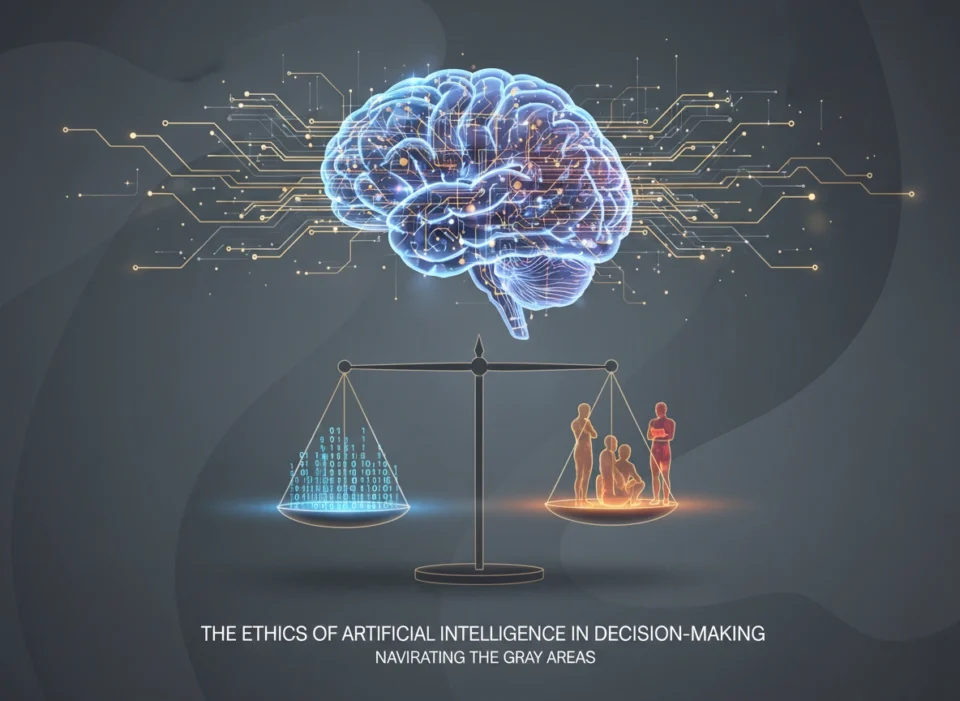
Artificial intelligence (AI) has moved rapidly from the realm of science fiction into the core infrastructure of our daily lives. We rely on algorithms to recommend the movies we watch, the routes we drive, and even the people we date. However, as AI systems take on more significant roles—deciding who gets a loan, who receives medical treatment, or who is flagged as a security risk—the stakes rise dramatically. The efficiency and speed of machine learning are undeniable, but they bring with them a profound ethical question: How do we ensure these digital decision-makers are fair, just, and accountable?
The ethics of AI in decision-making is not merely a technical problem to be solved with better code; it is a societal challenge that strikes at the heart of human values. As we hand over the keys to complex decision-making processes, we must rigorously examine the moral frameworks these systems operate within.
The Core Challenge: The “Black Box” Problem
At the center of the ethical debate is the issue of opacity, often referred to as the “black box” problem. Traditional software operates on explicit rules coded by humans: “If X happens, do Y.” Modern AI, particularly deep learning models, operates differently. These systems learn by processing vast amounts of data, identifying patterns that are often invisible or unintelligible to human observers.
When a deep learning algorithm denies a mortgage application, it might not be able to tell the bank officer exactly why. It simply weighs thousands of variables—from credit history to zip codes and spending habits—and outputs a probability score. This lack of interpretability creates a massive ethical hurdle. If we cannot understand the rationale behind a decision, how can we challenge it? How can we know if it was fair? Transparency is a prerequisite for justice, yet the most powerful AI systems are inherently opaque.
Bias in the Machine: Data as Destiny
One of the most persistent myths about AI is that it is neutral. We assume that because a computer has no emotions, it has no prejudices. This is a dangerous misconception. AI systems are trained on historical data, and historical data is a mirror of human history—complete with all its inequalities, biases, and systemic injustices.
If an AI system is trained to screen job applicants using resumes from the last ten years of a company’s hiring data, and that company has historically favored men over women, the AI will learn that being male is a predictor of success. It will then penalize female applicants, not because it is sexist in the human sense, but because it is mathematically maximizing the patterns it was fed.
Sector-Specific Implications
The consequences of these biases vary wildly depending on the sector in which the AI is deployed.
1. Healthcare: Life and Death Decisions
In healthcare, AI assists in diagnosing diseases, personalizing treatment plans, and managing hospital resources. While promising, the ethical risks are severe. For instance, an algorithm designed to allocate follow-up care for patients with chronic conditions was found to prioritize white patients over Black patients. The system used healthcare spending as a proxy for health needs. Because the healthcare system has historically spent less on Black patients due to systemic access barriers, the AI erroneously concluded they were healthier and needed less care. Here, a seemingly neutral metric (spending) encoded a deep racial bias, potentially leading to adverse health outcomes for marginalized groups.
2. Finance: The Gatekeepers of Opportunity
In the financial sector, AI drives credit scoring and loan underwriting. These decisions determine who can buy a home, start a business, or pay for education. When algorithms use “alternative data”—such as social media activity or online shopping habits—to assess creditworthiness, they risk creating digital redlining. If an algorithm correlates late-night fast-food purchases or specific zip codes with higher default rates, it may systematically deny credit to lower-income individuals, trapping them in cycles of poverty without ever explicitly considering their income or ability to repay.
3. Law Enforcement: Predictive Policing and Justice
Perhaps the most contentious application is in criminal justice. Police departments increasingly use predictive policing tools to deploy resources to “high-risk” areas. Similarly, courts use risk assessment algorithms to determine bail and sentencing. These tools rely on arrest data, which is often skewed by over-policing in minority communities. Consequently, the AI reinforces a feedback loop: it sends police to neighborhoods that are already heavily policed, leading to more arrests, which the data then interprets as validation that the area is high-risk. This automates inequality under the guise of objective data science.
The Accountability Gap
When an AI system makes a harmful decision, who is to blame? This is the accountability gap. If a self-driving car strikes a pedestrian, is the fault with the engineer who wrote the code, the company that deployed the fleet, or the car itself?
In corporate and legal settings, the diffusion of responsibility can be convenient for avoiding liability. Executives can claim they didn’t know how the algorithm worked; engineers can claim they just optimized for the specified metric. This “responsibility laundering” allows organizations to offload difficult ethical choices onto machines, insulating themselves from moral and legal repercussions.
We need clear frameworks that establish human responsibility for AI outcomes. A decision made by an algorithm is ultimately a decision made by the organization that deployed it.
The Importance of Human-in-the-Loop
To mitigate these risks, many experts advocate for “human-in-the-loop” systems. This means AI should serve as a decision-support tool rather than the final decision-maker. In a medical diagnosis, the AI might flag a potential tumor, but a radiologist must verify it. In hiring, an AI might rank candidates, but a human recruiter must conduct the interview and make the offer.
However, this solution has its own pitfalls, primarily “automation bias.” Humans have a tendency to trust automated systems over their own judgment or contrary evidence. If an AI creates a risk score saying a defendant is highly likely to re-offend, a judge may be hesitant to grant bail, even if other factors suggest leniency. Maintaining meaningful human oversight requires not just the presence of a human, but a human who is empowered, trained, and willing to overrule the machine.
Privacy and Surveillance
Ethical decision-making also involves respecting the subjects of those decisions. The fuel for AI is data, and the hunger for data drives pervasive surveillance. To make better decisions about employees, companies might monitor keystrokes, email sentiment, and even bathroom breaks. To make better decisions about consumers, retailers track physical movements in stores and cross-reference them with online profiles.
This erosion of privacy alters the power dynamic between institutions and individuals. When an entity knows more about you than you know about yourself, the potential for manipulation—nudging you toward purchases, political views, or behaviors—grows exponentially. Ethical AI must respect the boundary between useful insight and invasive surveillance.
Moving Toward Ethical AI: Recommendations for the Future
Addressing these ethical challenges requires a multi-faceted approach involving policymakers, technologists, and business leaders. We cannot wait for disasters to occur before implementing safeguards.
1. Diverse Development Teams
Homogenous teams create biased products. If the engineers building an AI system all share the same background, gender, and socioeconomic status, they are less likely to spot potential biases or foresee how the system might harm marginalized groups. Diversity in tech is not just an HR initiative; it is an ethical necessity for building robust AI.
2. Algorithmic Auditing and Impact Assessments
Just as companies undergo financial audits, they should undergo algorithmic audits. Third-party experts should test AI systems for bias, accuracy, and security before deployment and regularly thereafter. Impact assessments should be mandatory for high-stakes AI applications, forcing organizations to document potential risks and mitigation strategies before writing a single line of code.
3. Explainability by Design
We must prioritize “Explainable AI” (XAI). Researchers are developing techniques that allow deep learning models to reveal which features influenced a specific decision. Regulators should mandate that for decisions affecting fundamental rights—housing, employment, credit, justice—the AI must be able to provide an explanation in plain language. If a system is too complex to be explained, it may be too dangerous to be deployed in critical sectors.
4. Regulation and Governance
Self-regulation is insufficient. Governments must establish legal frameworks that define liability and set standards for fairness. Regulations like the European Union’s AI Act are steps in the right direction, categorizing AI systems based on risk and imposing stricter requirements on high-risk applications.
5. Ethics Education for Technologists
Computer science curricula often focus heavily on optimization and performance, with ethics relegated to an elective. Ethics must be integrated into the core of technical education. Engineers need to understand that their code has social consequences and that efficiency should not always trump equity.
Conclusion
The integration of artificial intelligence into decision-making processes offers immense potential to improve efficiency, reduce costs, and even make our world fairer by removing human inconsistency. However, without rigorous ethical oversight, it threatens to automate inequality, obscure accountability, and erode privacy.
We are at a critical juncture. The decisions we make today about how to build, govern, and deploy AI will shape the societal landscape for generations. We must demand that our digital tools reflect our highest aspirations for justice and fairness, rather than merely magnifying our past mistakes. Ethical AI is not an impediment to innovation; it is the only sustainable path forward.
Please visit website for more info.
