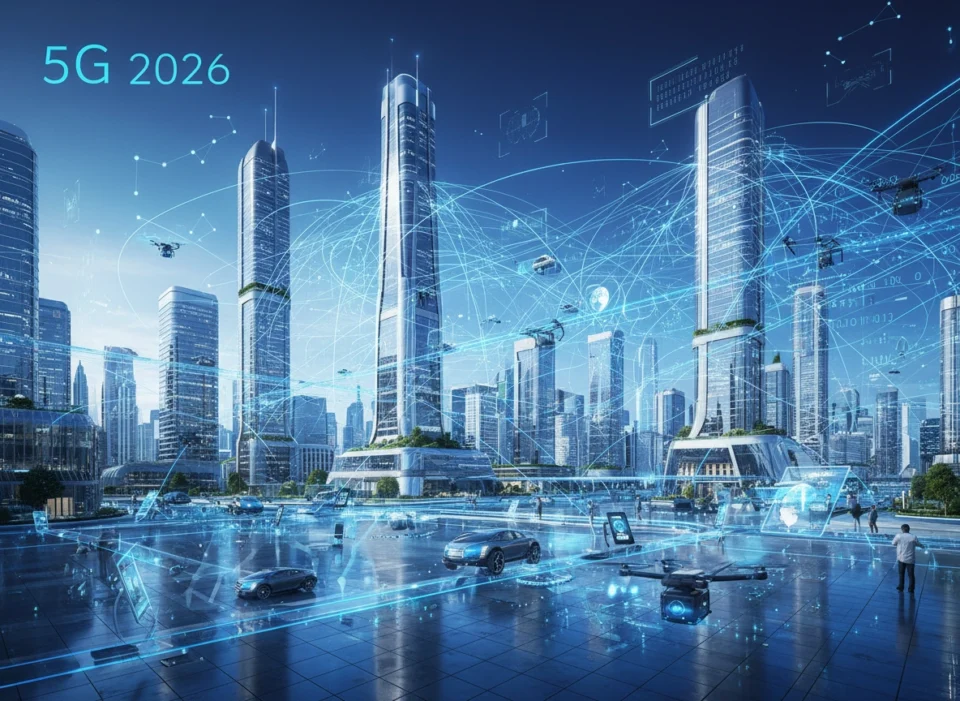
The rollout of 5G networks has been one of the most anticipated technological shifts of the last decade. While the initial hype focused on faster download speeds for smartphones, the true potential of this technology is only now coming into focus. As we move through 2025, the infrastructure is maturing. By 2026, we expect to see a pivotal shift where 5G stops being a “new feature” and becomes the invisible backbone of a hyper-connected society.
This article explores the trajectory of 5G technology, looking specifically at the advancements, industry impacts, and challenges we anticipate for the year 2026.
The State of 5G in 2025: A Foundation Laid
Before looking ahead, we must understand where we stand today. In 2025, 5G is no longer a novelty. Most flagship and mid-range smartphones are 5G-enabled by default. Major metropolitan areas across North America, Europe, and parts of Asia have robust coverage. Carriers have largely moved past the non-standalone (NSA) networks—which relied on 4G cores—to standalone (SA) 5G architectures.
This shift to standalone architecture was crucial. It unlocked the low latency and massive device density that 4G simply couldn’t handle. However, rural coverage in 2025 still lags behind urban centers, and the promise of “gigabit speeds everywhere” remains unfulfilled for many consumers. We are currently in a phase of consolidation and optimization, setting the stage for a leap forward in 2026.
Predictions for 2026: Speed, Coverage, and Reliability
The year 2026 will likely mark the transition from “deployment” to “refinement and densification.” Here is what users and enterprises can expect regarding network performance.
The Rise of 5G Advanced (5.5G)
By 2026, the conversation will shift toward 5G Advanced, often referred to as 5.5G. This isn’t 6G yet, but a significant mid-generation upgrade. We predict that 5G Advanced will introduce uplink speeds that finally rival downlink capabilities. For content creators and industrial applications, upload speed is often the bottleneck. 5.5G aims to fix this, potentially offering uplink speeds of 1 Gbps or higher in optimal conditions.
True Ubiquity in Urban Canyons
Coverage issues in dense cities—often caused by buildings blocking high-frequency millimeter wave (mmWave) signals—will see major improvements. We expect to see widespread deployment of massive MIMO (Multiple Input Multiple Output) technology and intelligent repeaters. These technologies will beam signals around obstacles more effectively, ensuring that your connection doesn’t drop when you turn a street corner.
Reliability as a Service
In 2026, reliability will become a marketable metric, perhaps even more than speed. Networks will offer “five nines” (99.999%) reliability guarantees for enterprise clients. This level of stability is essential for mission-critical applications where a dropped connection could mean a stopped production line or a failed surgical procedure.
Transforming Key Industries
The real story of 5G in 2026 won’t be about how fast you can download a movie. It will be about how industries operate.
Healthcare: Beyond Telehealth
Healthcare has already adopted basic telehealth, but 5G will deepen this integration. By 2026, we anticipate the normalization of remote patient monitoring through high-fidelity wearables. These devices will transmit real-time data on heart rate, glucose levels, and oxygen saturation without draining battery life, thanks to 5G’s energy efficiency.
Furthermore, telesurgery will move from experimental pilots to practical application. With latency dropping below 5 milliseconds, a surgeon in New York could control a robotic arm in a rural clinic hundreds of miles away with near-instant feedback. This democratization of specialized care could be the most significant social impact of 5G.
Manufacturing: The Smart Factory Realized
Manufacturing is arguably the biggest beneficiary of industrial 5G. In 2026, factories will increasingly cut the cables. Private 5G networks will allow for “reconfigurable factories.” Because machines won’t be tethered by ethernet cables, production lines can be rearranged in hours rather than weeks to accommodate new product runs.
We also predict a surge in “digital twins.” Manufacturers will create virtual replicas of their physical systems. Sensors will feed real-time data to the twin via 5G, allowing AI to predict machinery failures days before they happen. This predictive maintenance could save the global manufacturing sector billions annually.
Transportation and Logistics
In transportation, Vehicle-to-Everything (V2X) communication will become a standard feature in new 2026 vehicle models. Cars will talk to traffic lights, parking garages, and each other. This doesn’t just mean fewer accidents; it means optimized traffic flow. A 5G-connected traffic grid can adjust signal timing in real-time based on actual traffic volume, reducing congestion and emissions.
Entertainment: The Death of the Console?
For entertainment, 2026 could be the year cloud gaming truly rivals local hardware. With stable, high-bandwidth 5G, the processing power for video games will move entirely to the cloud. Gamers will play graphically intense titles on simple screens without needing expensive consoles. Additionally, live sports broadcasting will evolve, offering fans the ability to switch between 360-degree camera angles instantly on their tablets while at the stadium.
Enabling Emerging Technologies
5G is the soil in which other technologies grow. Without it, many futuristic concepts remain stagnant.
The Internet of Things (IoT) Explosion
We have talked about IoT for years, but 4G networks could only support a few thousand devices per square kilometer. 5G can support up to one million devices in the same space. By 2026, this density will enable “Massive IoT.” This means everything from smart streetlamps that dim when no one is around to agricultural sensors that water individual crops only when necessary. The sheer volume of connected devices will explode, creating a data-rich environment for city planners and businesses.
AR and VR: Untethered Experiences
Augmented Reality (AR) and Virtual Reality (VR) have suffered from a “wire problem.” High-quality VR usually requires a cable connected to a PC. In 2026, 5G’s high bandwidth will render these cables obsolete. Processing will be offloaded to edge computing servers (servers located physically closer to the user). This will allow VR headsets to become lighter, cheaper, and more comfortable, finally pushing them into the mainstream consumer market.
Autonomous Vehicles
Self-driving cars generate terabytes of data daily. They cannot process all of this locally, nor can they rely on slow connections to upload it. 5G provides the pipeline for this data. By 2026, while fully autonomous Level 5 vehicles may still be rare, we will see significant deployments of autonomous trucking fleets on highways, coordinated via 5G networks to drive in fuel-efficient platoons.
Challenges and Roadblocks
Despite the optimism, the road to 2026 is paved with challenges.
The Spectrum Crunch
Finding available radio spectrum is becoming increasingly difficult. The “sweet spot” mid-band spectrum (which balances range and speed) is crowded. Governments and regulators will need to work aggressively to clear old spectrum bands for 5G use. If they fail, network congestion could increase despite better technology.
Infrastructure Costs and ROI
Building a 5G network is incredibly expensive. It requires more cell towers and more fiber optic cabling than previous generations. Carriers are struggling to monetize these investments. If consumers are unwilling to pay a premium for 5G, and if enterprises don’t adopt private networks fast enough, carriers might slow down their investment in rural and suburban expansion.
Security Concerns
With billions of new devices connected to the network, the attack surface for cybercriminals expands exponentially. A 5G-enabled hospital or power grid is a high-value target. Security standards for IoT devices are currently lax. By 2026, the industry will face a reckoning regarding cybersecurity, likely necessitating strict government regulations on IoT security protocols.
The Digital Divide
There is a real risk that 5G will widen the gap between the digital “haves” and “have-nots.” While cities enjoy 5.5G speeds, rural areas might still struggle with basic connectivity. Bridging this divide will require public-private partnerships, as market forces alone often do not incentivize rural deployment.
Conclusion
The year 2026 represents a maturation point for 5G. We will move past the marketing buzzwords and into an era of tangible utility. The technology will fade into the background, becoming as essential and invisible as electricity.
From enabling remote surgeries that save lives to powering factories that reconfigure themselves, 5G will act as the central nervous system of the modern economy. While challenges regarding cost, security, and equity remain, the trajectory is clear. The future isn’t just about faster phones; it’s about a smarter, more responsive, and deeply connected world. For businesses and consumers alike, preparing for this shift is no longer optional—it is essential.
Please visit website for more info
